One Bad Apple

I recently took a day-trip to Couer d’Alene, ID (an absolutely beautiful area, I highly recommend a visit). Anyway, while I was there, I came across a big street fair with vendors from all over the area.  Clothing, jewelry, food galore, and mixed in the crowd was a PETA demonstration. 

Participants were dressed in black clothing and white masks, and were holding screens that played videos showing animal abuse.  The ag community continually struggles sharing our story with consumers, while this group can confidently degrade everything we are working towards.  Now, I know many people don’t fully trust PETA’s representation of the industry, but often think, “they had to get the video from somewhere.”   

The easiest way for me to think about and describe the work PETA is doing, is with the following scenario:

Imagine that you were at a farmer’s market.  A beautiful day with booths full of fresh flowers, fruits and vegetables all grown locally.  You stop at a stand, Annie’s Apples, to buy fruit for the week.  While looking at the big, shiny, red apples, you come across one that is small, disformed, bruised and just mushy.  Rotten. 

Seeing this rotten apple, you decide that if she had one bad apple, the rest of them at her stand must not be worth buying.  Annie doesn’t raise her apples properly.  If this one is bad, how can the rest be good?  She can’t be trusted. 

You then tell your friend’s not to buy apples from Annie.  This develops as you and your friends share on social media a picture of the gross little apple.  Now, all your connections not only think that Annie’s apples are bad, but every farmer must produce those bad apples.  They’re not only skeptical of buying apples from Annie, but from any apple producer.  No apples from farmer Annie, Adam, Alex, etc., etc.  Since their apples can’t be trusted, that means they can’t be trusted.  They’re abusing the apples just to make a quick buck.  They don’t actually care about the apples or the people eating the apples.

This scenario seems a little crazy, right?  Who would purposely abuse an apple?  And if one person thought that was a good idea, does it make sense that every apple farmer would purposely sell rotten fruit?  No. If an apple is bruised it isn’t going to taste good, and will cost the farmer money by trying to sell a poor-quality product.

Well, the same thing is true of animal agriculture.  Most farmers care deeply about their livestock.  Stress causes the animals to lose weight, makes it more difficult to care for their young, lowers their milk producing ability, causes meat quality problems.  Basically, stressed animals go against every goal that a farmer has for his livestock.  Those videos come from bad apples; often in the form of undercover, ‘animal rights activists’ working on farms.

Yes, there are a few bad apples out there.  There always has been, and there always will be.  But next time you see something posted, or maybe an in-person PETA protest, I hope that you don’t let one bad apple destroy your opinion on the whole bunch.

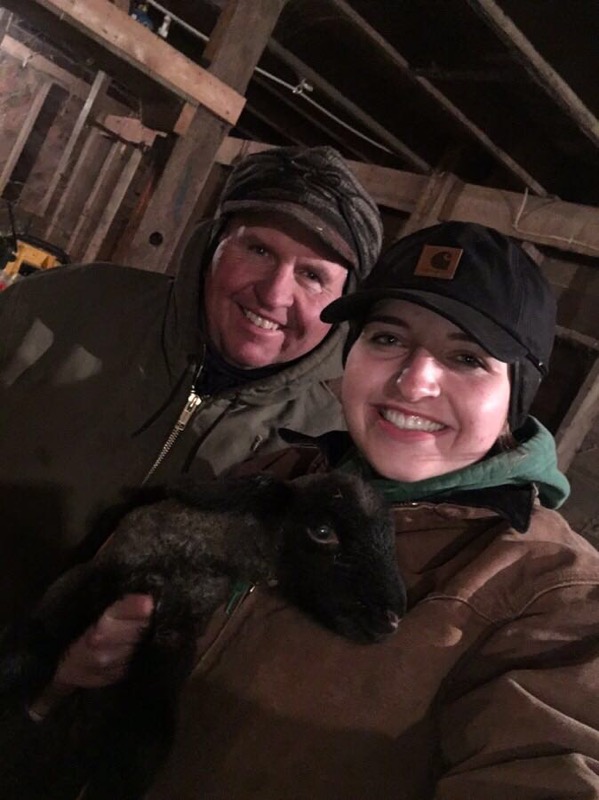
Calving Season

The story of a steak begins long before it finds your plate.  In fact, for this story to begin, we must rewind over two years from when you purchased that steak, to baby making season…

Farmers make careful genetic decisions to improve their herd and the quality of meat that the animals produce.  There are numbers called Expected Progeny Differences (EPDs), that help producers predict how specific traits will be passed down to future generations of livestock.  Think of these numbers like batting averages.  That number helps you predict how your favorite player will hit and gets more accurate every time he is up to the plate.  EPDs work the same way; helping producers make decisions with their accuracy improving with the more offspring an animal has. EPDs are often used if a farmer is buying a bull or choosing one to use for artificial insemination.   These predictions can be specific for birthweight, ribeye area, marbling ability, and much more.

Natural breeding is common to the beef industry, but many operations incorporate artificial insemination into their program. Artificial insemination (AI) is an incredible technology that producers can use to help improve their herd genetics.  To use AI, semen is collected from the male, frozen and can then be shipped all over the world (In fact, when I visited a farm in China, they were using semen from a bull owned by a farmer I know in South Dakota!).  AI can be a relatively low-cost option to farmers to purchase limited quantities of semen, rather than making a large investment in a bull.  AI can be very successful for many operations and allow for specific breeding choices to be made, improving livestock quality.  

So now that the cows are bred, they need to be taken care of in terms of nutrition, health and environment to ensure a healthy calf is born.  Working with nutritionists and veterinarians help ensure that the cows are getting the nutrients that they need and are cared for. 

Then, about 283 days later…. it’s baby time!  Calves are born and a whole new round of excitement begins.  It’s calving season right now, and many farmers and ranchers are keeping busy. This winter has been hard on a lot of producers and livestock.  Farmers check on the livestock day and night to ensure new calves can be dried off and warmed up.

When a calf is born, it is important for them to be able to stand up and eat.  The first milk that they receive from their mama’s is colostrum.  Colostrum contains antibodies and nutrients that are passed on to the offspring.  This first meal is vital for future health of the animal. 

It is important to care for the calves during this time, but it is also necessary to keep a close eye on the cows.  The cows need to be fed a good diet that provides them enough energy to maintain themselves, as well as helping their calf grow strong and healthy.

This is just the beginning of the story of how meat makes it to your kitchen table.  Simply having a calf turns into a big process and requires so much time and hard work; from selecting a bull, to breeding, to keeping the cow healthy, to calving.  But all that hard work pays off knowing that it is the first step in providing a high quality product for consumers.  

A Picture of Life on the Farm

Recently my Facebook timeline has been full of people doing a “10-day farming and ranching challenge.”  A picture each day for 10 days showing what life on the farm looks like but without any explanations.  Just a picture, no words. 

Now, I know that a picture is worth a thousand words, but sometimes a little context is a good thing.  This week, I am going to take a little detour from our meat safety and quality conversations and share a little insight into what being involved in agriculture has looked like for me. 

This time of year is so exciting on the farm because babies are being born!  I have so many great memories going out late at night with my dad to see if any lambs or calves were born. Right now, my family is in the midst of both lambing and calving.  There have been some extremely cold temps and snowy days the past few months in South Dakota; however, it doesn’t matter what the temperature is outside, farmers and ranchers don’t get a snow day.  They go to work, day and night, to ensure that their livestock is cared for.

Blue sky, green grass, black cattle, one of my favorite views!  Every summer, we bring our cattle to the pasture for a few months.  After long, dreary winters, it is so encouraging to see new life, both in the vegetation and in the baby calves! 

Putting up hay.  Not exactly the most fun job on the farm (or photogenic), but it’s work that needs to be done.  Typically, it’s the hottest days of the summer when the hay is ready to be put into the barn.  It’s a hot, dusty, job.  Storing hay during the summer gives us an ample supply to use during the winter during lambing and calving.  Square bales (like what is in the picture), can be used for bedding or as feed, depending on what the bale is made of.  It may be a lot of work in the summer, but when winter comes along we are sure thankful that the job got done!

I know that this isn’t a farm picture, but I had to include it.  It is still crazy to me to think that someday I am going to be a meat scientist.  How crazy is that?!  The agricultural industry offers so many opportunities for careers outside of farming and ranching; meat science, nutrition, genetics, and so much more.  I am so excited to see where this path leads me and what opportunities lie ahead!

You simply can’t beat South Dakota sunsets!  I grew up looking at this view every day.  I am so thankful to have grown up on a farm and for all the values that it instilled in me.  I learned the value of hard work and how to work as a team.  No matter where I end up in the future this will always be one of my favorite views.

Most importantly, on a farm  you don’t go to an 8-5 job where you become acquaintances with your co-workers.  Farms run on families.  Did you know that 98% of farms are family owned and operated?  Farming isn’t just a job, it’s a lifestyle; one that everyone must commit to.  Whether it be working with livestock, harvesting crops, putting up bales, or making meals for the people in the field; everyone is involved.  I’m so thankful for this bunch and couldn’t have asked for a better crew to call my family.

These are just a few photos are just a snapshot of what life on the farm looks like. I am so thankful to be involved in this industry and I hope this detour gave you a look into the ag world!